Kamis, 31 Desember 2015

Book Review: The Making of The President 1960

The Making of the President 1960The Making of the President 1960 by Theodore H. White

My rating: 5 of 5 stars


The Making of The President 1960 earned the author, Theodore H. White, a Pulitzer Prize in 1962. In the book, White, a journalist, follows the candidates from the moment they made the decision to enter the race for the Presidency until Kennedy was elected.


In the 1970’s I had White’s The Making of the President 1968, the third of 4 books in the series. I was impressed with book when I read so decided with being on the doorstep of the 1916 election that I would read the original book in the series.


The Making of the President 1960 is as relevant and important today as it was in 1960. White has the reporter’s knack of capturing the detail that makes the story exciting even 55 years after the event. Many of the issues that he identifies in the 1960 campaign are still relevant today. He also has a strong sense of history and is able to put the events of the time in historical context.


White touches on the fact that the peaceful transfer of power from one person to the next is unusual in the annals of history. White writes:


“Heroes and philosophers, brave men and vile, have since Rome and Athens tried to make this manner of transfer of power work effectively; no people have succeeded at it better, or over a longer period of time, than the Americans.”


The Democrats seeking the nomination of their party in 1960 included Senator Hubert Humphrey of Minnesota, Senator Stuart Symington of Missouri, Senator Lyndon B. Johnson of Texas, former Illinois governor Adlai Stevenson II and Senator John F. Kennedy of Massachusetts. The Republicans seeking the nomination of their party in 1960 were Governor Nelson Rockefeller of New York and Vice-President Richard M. Nixon.


White is excellent at summing up a situation in a very simple image. After Humphrey had lost the primary in West Virginia that ended his campaign, White writes: “In the morning, when Humbert Humphrey woke, the Presidential image had evaporated. Outside the Ruffner Hotel his parked bus had overnight been given a ticket for illegal parking.”


Lyndon Johnson, like some politicians today, was seen as being too close to the workings of Washington. Johnson’s weakness was that he believed that the Senate was America and that he was the Senate. In a very relevant passage, White writes: “Long service in Washington at the court of power decisions causes men to forget that power rises ultimately from beyond the Potomac.”


Here is one of White’s descriptions of Kennedy: “He had mastered politics on so many different levels that no other contemporary American could match him. He had nursed ward politics with his mother’s milk; heard it from his grandfathers, politicians both, in boyhood; seen it practiced from his father’s embassy in London at the supreme level of world events in 1939, as war and peace hung in the balance.”


White fills his book with telling details. He writes: “At almost any moment of afternoon and evening on the road, soup is the favorite Kennedy dish — almost any kind of soup: chicken soup, tomato soup, bean soup and his favorite New England clam chowder.”


White reviews in detail the impact of the changing demographics on the politics of the time. Between 1950 and 1960, the population of the country grew by 18%. Forty-one million Americans were born during the period and 16 million died. Two-thirds of the growth had occurred in the suburbs.


White also discusses immigration which statistically began being counted in 1819 as required by Congress. White writes, “in 1820 America held 9,638,000 people, of whom almost 20 per cent were Negroes; and the rest are considered to have been the parent ‘colonial stock’ of America — an overwhelmingly British stock, spiced lightly with adventurers from all northern Europe.”


Over 40 million immigrants entered the country between 1820 and 1960. The Irish came first. Between 1847 and 1854, over one million Irish entered the country. Almost 900 thousand Germans came between 1850 and 1857 and they kept coming in waves. By 1960 people with German heritage had become the second largest component of the American population. The Scandinavians arrived in the late 1800s. In the early part of the 20th century, more than 3 million Italians arrived.


White also writes about the issue of religion. He reminds us that many of the early settlers came to escape the religious wars of Europe. The memories of how they were punished in Europe for their religious beliefs led to the decision that government had no right to make inquiry into the faith of its citizens and that the state should not have any connection to religion. People were free to worship as they pleased without guidance from the government.


I think every American would benefit from the reading and rereading of this book as we enter another election year. White is a great storyteller who helps us understand how politics work and how Presidents are elected to serve the people.


View all my reviews


Senin, 28 Desember 2015

Paulo Coelho


I remember when I first started writing I would ask the question that many people who first find the creative path ask: Do I have talent? And I hoped that some wise teacher would say that I was a talented writer and that I should devote myself to writing. Now, having trod this path for years, I know that no one can affirm or deny my talent. It is what it is. We all have creative gifts. We can either put our talent to good use or squander it.  We can either walk the creative path or become lost in chaos of creation.

There is a deeper and more important question within the question. When we ask do we have talent, the hidden question is: Will I be rich, famous and successful? And the answer for many of us on the creative path is no. Most creative leaders will work in obscurity and receive only a pittance for their labors. If money and fame is your desire, there are easier paths to walk. To walk the creative path is do it because you love it. The choice is yours.

Senin, 21 Desember 2015

Georgia O'Keefe


How much do we miss because we don't take the time to see it? How many sunrises or sunsets have you spent time just enjoying the beauty? Or are you like me — running from place to place, not spending time enjoying the beauty of nature? I have lived through over 24,000 sunrises and 24,000 sunsets. I would be lucky if I saw 200 of them. I could probably count on one hand those I remember. How much we miss because we are busy elsewhere!!


How many birthdays have you missed? Yours? Those you love? Our birthdays are one of the important days of our lives.  It is the day we came into this world. Some of us don't like birthdays because we had a bad experience as a child. My wife tells the story about how her family forgot her birthday one year when she was a child.  They failed to celebrate her life.  For the past several years I have made the choice to take off work on my birthday? I take the entire week off, not just the day. 


How much have you missed in the lives of your children or grandchildren because you were too busy to stop and enjoy a few precious moments with them?  Life is about the memories we make with those we love.  For some of us we will wake up one day and realize that our children have grown up and have gone on living without us.  


Life is a gift that we need to celebrate and appreciate.  Take a few precious moments this evening and watch the sunset.  Wake up tomorrow and watch the sunrise.  Choose to slow down and enjoy the moments in your life.

Senin, 14 Desember 2015

Theodore Roethke


Many of us are afraid of silence. We have a need to fill the the air waves with noise — television, radio, music. And for those living in cities there are the sounds of cars, trucks, sirens, airplanes and neighbors fighting. We don't feel comfortable when the conversation dies and we are left with silence.  We rush to fill the void. We experience silence as emptiness. 


I enjoy external silence because it allows me to think. Silence allows me to explore the backroads of my mind. Silence releases my creativity. But I rarely experience internal silence. Even when I sleep my mind is filled with dreams.  My thoughts are always bubbling to the surface, brandishing their weapons. 


When I teach people to speak in public, I talk to them about the importance of silence — of learning the pregnant pause, of giving your audience the time to catch up with your words. Storytellers understand the power of silence. We must learn to appreciate silence, to enjoy its many flavors. Sometimes we can learn more from silence than the words spoken or written.


Can you hear the silence when you are painting? Do you listen to the silences between the words that you write? 

Senin, 07 Desember 2015

General Colin Powell


Some people look for the easy way, the next get rich scheme and the short-cuts to the top. I had a brother-in-law like that. He was always looking for the business opportunity that would make him rich. He fantasized about retiring to a beach in Cabo, Mexico. Yet, he was never willing to invest the time and hard work it takes to become successful.  He was always moving onto the next great idea that would make him rich. He died with his dream unfulfilled. Even on his death bed, he was still scheming how to make his first million.


Practicing any of the arts takes patience, hard work and persistence. Nothing happens overnight. Many people quit too soon. They become frustrated because what they produce does not match what is in their imagination. And this quitting begins early in life. I recently saw a four-year old girl who was working on a painting of the ocean become frustrated because the painting did not match what was in her mind. She burst into tears. Has this happened to you? Do you become so frustrated that you quit? Do you give up on your work?


If you want something bad enough, you have to prepare, work hard, and learn from your failures. As artists and writers we understand this because we sometimes labor for years or even a lifetime with little or no success. My words are simple: keep writing, keep painting, keep living.


Senin, 30 November 2015

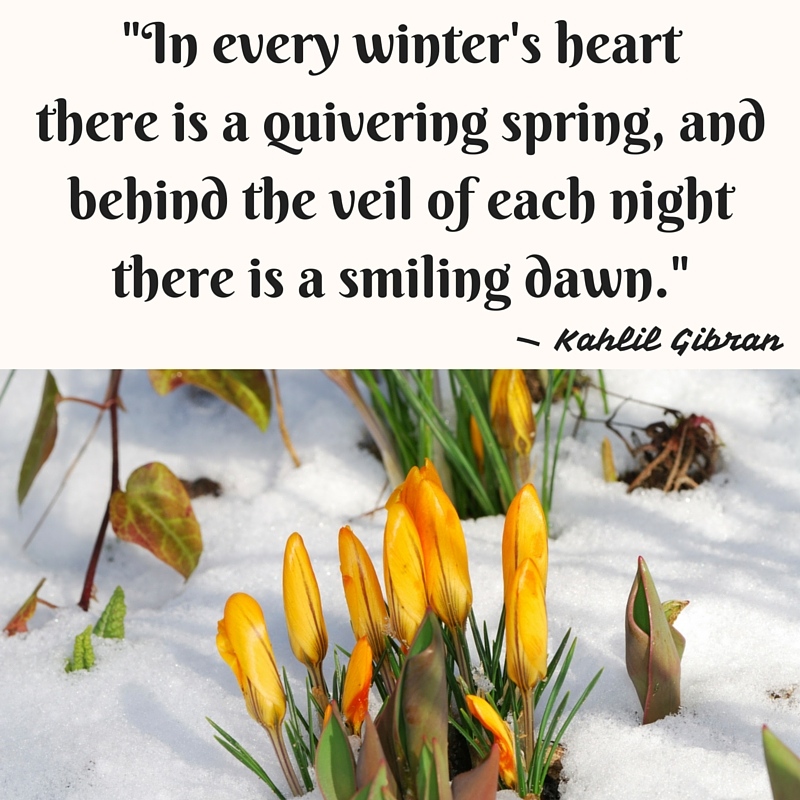
Kahlil Gibran


Hope is an essential gift we have been given as human beings. Hope is the capacity for believing that tomorrow will be better. Without hope, we are wandering through a dark, desolate world. We are at the mercy of our fears and doubts. Hope allows us to see beyond the current trouble we are experiencing. In even our worst moments, we need to remember that life will get better. There is always light at the end of the tunnel, even when we can't see it.


As artists, writers and creative leaders, we need to believe that the next painting or the next poem will be our best. Hope keeps us writing, painting and acting in the face of self-doubt and failure. If we were to quit now, we would never know what was around the next corner or what opportunities lay ahead.


As creative leaders need hope because we live in a very negative, sometimes hostile world, that often does not understand or appreciate our creative work. I have been writing seriously for almost forty years and have yet to receive acceptance and recognition for the work I have produced. Another person might have quit many years ago, but I keep plugging away.

Do you have faith in your creative ideas? Your poems? Your stories? Your paintings? Your ability to become another person on stage? Do you have dark days when you want to quit and live a normal life? Hope keeps us going even when everything and everybody around us are telling us to give up — that we have no talent, no gift.

What keeps you going during those darkest of hours? Why do you believe in your ideas? Where does your hope come from? Don't give up. Keep dreaming. Keep hoping. Keep believing. In every winter you will find the flowers of spring.

Senin, 23 November 2015

Joye Moon


How do you begin your day? With a cup of coffee? A cold beer? With steak and eggs? Or a doughnut? Do you drag yourself out of bed wishing you could spend the day sleeping? Are you wide awake and full of energy?  Do you hit the snooze button again and again trying to steal a few more minutes of sleep? Do you sing in the shower and dance about the room?


While my wife and I are both early risers, we approach our mornings differently. She loves sound and light.  She turns on the TV so noise fills room.  She turns on the lights around the house chasing away the darkness.  I, on the other hand, prefer silence so I can give free rein to my thoughts.  Mornings are my creative time.  Ideas seem to spring out of nowhere.  I don't want to talk. I don't want any external noise disrupting my thoughts.  My thoughts are enough noise. We both are enthusiastic about the day, but approach it differently.


Some people get up in the morning and say: "Good morning, Lord. It is great to be alive!" They are full of energy and enthusiasm.  Other people get up and say: "O Lord, it's morning again." They start the morning in reverse and keep going backwards. Which person are you? Someone who appreciates each day she has been given? Or someone who finds no joy in living and finds fault with the world? 


How you begin your day can have a positive or negative impact on your creative work. Do you begin your day with meditation? Or prayer? Do you take a walk? Or lift weights? Do you eat a healthy breakfast or do you skip the most important meal of the day? 


Be thankful for every day you wake up. The alternative to waking up is being six feet under. Celebrate the day and give thanks for all you have been given. Every day is an enchanted gift — an opportunity to begin again.  Greet the morning with enthusiasm and hope.